

Who was Hannah Arendt?
Hannah Arendt was a German-born political thinker who lived during the 20th century (1906–1975). She experienced major historical events, including escaping Nazi Germany, which deeply influenced her work. Arendt focused on understanding power, responsibility, and how people behave in society, especially during times of crisis.
She believed philosophy should help explain real-world problems, not just abstract ideas. Her work explored how ordinary individuals can become part of harmful systems when they stop thinking critically.
Example:
In school, students may follow group behavior without questioning it.
Have you ever followed others without thinking? What might change if you paused and reflected?

1 / 3

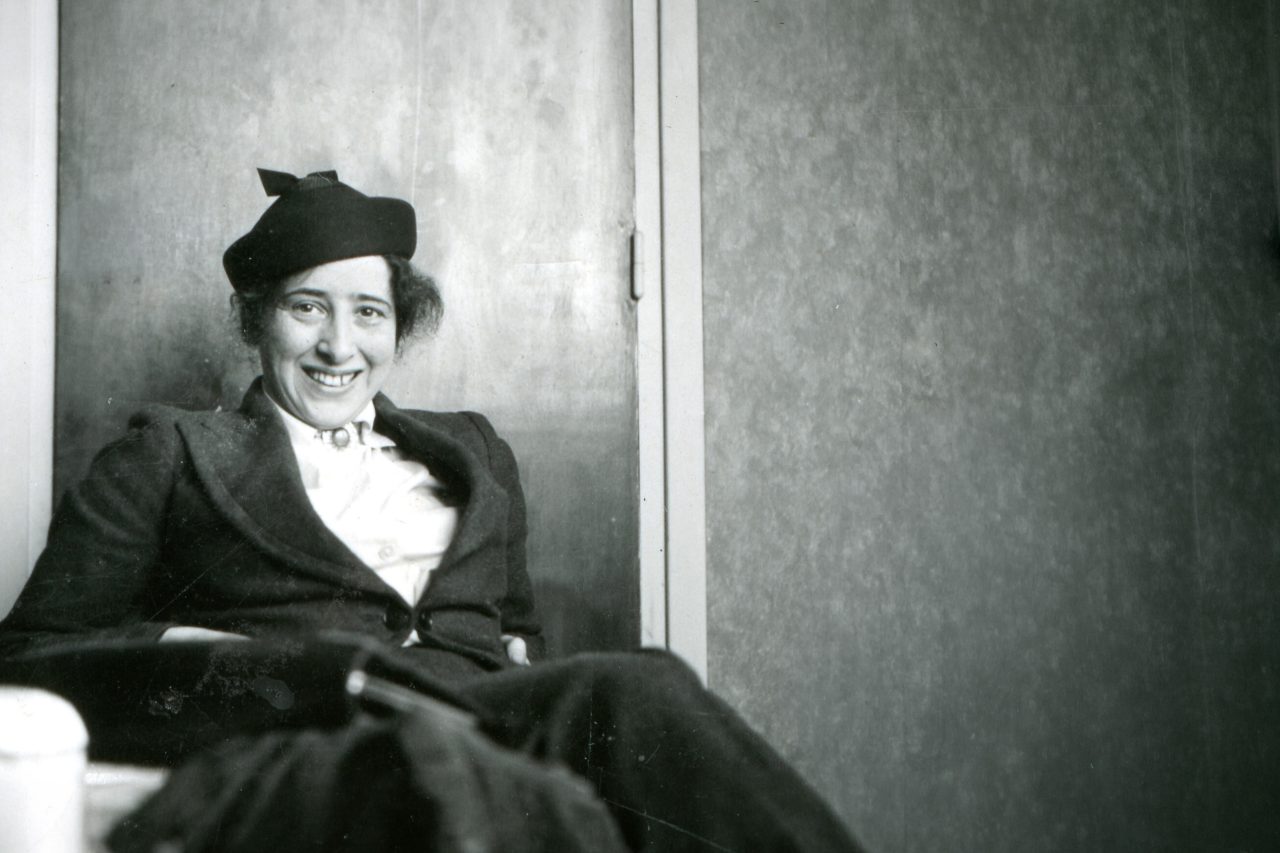
Hannah Arendt
What is the “banality of evil”?
Arendt developed the idea of the “banality of evil” after observing the trial of a Nazi officer, Adolf Eichmann. She expected to see a clearly cruel or hateful person, but instead found someone ordinary who claimed he was just following orders. This led her to argue that great harm can occur not only because of evil intentions, but because people fail to think critically about their actions.
According to Arendt, when individuals stop questioning authority or social norms, they may become part of harmful systems without realizing it. This makes thoughtlessness a serious ethical problem.
Example
Imagine you see someone being excluded from a group activity. You feel uncomfortable, but you say nothing because you don’t want to stand out or cause conflict.
Over time, this silence allows the situation to continue. Others may also stay quiet, assuming it is acceptable behavior.
Even though no one directly caused the harm, the lack of action contributes to it.
Think about it:
When have you stayed silent in a situation like this? What might happen if someone chose to speak up?
1 / 4

En mann som går på jobb, jobber og går hjem
Why is thinking important?
Thinking is not only about learning facts, but about reflecting on our actions and making responsible judgments. She believed that thinking creates an inner dialogue where we question what we are doing and why. This process helps us avoid acting automatically or blindly following others.
Without thinking, people may follow rules, authority, or social pressure without considering the consequences. Arendt saw this as a serious problem, because it can lead individuals to participate in harmful situations without realizing it. Thinking, therefore, is essential for ethical responsibility and personal awareness.
Imagine this situation:
You are in a group where people start making jokes about someone who is not present. You feel uncomfortable, but at first you laugh along without thinking.
Then you pause and reflect on how those jokes might affect the person if they heard them.
You decide to stop participating or change the topic, even if it feels awkward.
So, let’s think about this…
When do you usually take time to reflect on your actions? How could thinking more carefully change your behavior?
1 / 4

En mann som sitter og tenker
What is “action” in Arendt’s philosophy?
Action is a central part of human life. It involves communication, participation, and the ability to influence the shared world. Action is different from routine behavior because it requires intention and interaction with others. Through action, people express their identity and contribute to society.
For Arendt, an action often involves uncertainty and risk, because we cannot control how others will respond. However, this is also what makes action meaningful—it allows new ideas and possibilities to emerge.
Imagine this situation…
Imagine you are in a class discussion and disagree with the majority opinion. At first, you hesitate to speak because you fear being judged. After reflecting, you decide to share your perspective respectfully.
Your contribution changes the discussion, and others begin to consider different viewpoints.
How can speaking up—even when it feels difficult—change a situation?
1 / 3

En gruppe papirfly som flyr i én retning, mens ett enkelt fly peker i en annen retning
Responsibility in society
Arendt argued that responsibility always belongs to individuals, even within systems or groups. She rejected the idea that people can avoid responsibility by saying they were following orders or doing what others expected. Instead, each person must think critically and make their own judgments.
This idea is especially important in social situations, where actions affect others directly or indirectly. Taking responsibility means recognizing consequences and being willing to act differently when something is wrong.
Imagine your friends decide to exclude someone from an activity. You know it is unfair, but you feel pressure to go along with it.
After thinking about it, you decide to include that person or speak up. Your choice may feel uncomfortable, but it helps create a more fair and respectful environment.
What do you think? When is it hardest to take responsibility for your actions?
1 / 3

Trefigurer der én skiller seg ut i blått blant resten
What is the role of a community?
Community is essential because it is where human life becomes meaningful. People develop their identity through interaction, communication, and shared experiences. Community allows individuals to express themselves, exchange ideas, and take action together.
Arendt believed that a shared world is created through relationships and cooperation. Without community, people would lose the space where they can act, speak, and connect with others.
If you are in a classroom where students support each other, listen, and work together, this creates a positive and respectful environment. But if you are in a classroom where people ignore or exclude others, the atmosphere becomes uncomfortable and less productive.
These differences show how individual actions shape the community.
Let’s reflect…
What kind of environment do you help create in your daily life?
1 / 3

En gruppe mennesker som klemmer hverandre
What is freedom?
Freedom is not only about personal choices, but about participation in public life. It involves speaking, acting, and engaging with others in meaningful ways. Freedom exists when people can express ideas and contribute to the shared world.
For Arendt, freedom requires responsibility and interaction. Without participation, people may have choices, but they are not fully exercising their freedom.
For example, if you are in a discussion where only a few people speak while others remain silent. As more people begin to share their ideas, the conversation becomes richer and more dynamic. This shows how freedom grows when people actively participate.
Think for yourself:
How can you use your voice to contribute to your community?
1 / 3

En universitetsstudent stiller et spørsmål under en forelesning i et klasserom
Why is Arendt relevant today?
Arendt’s ideas are especially relevant in today’s world, where information spreads quickly and people are constantly influenced by social media, news, and group opinions. In this environment, it is easy to act without thinking, follow the majority, or share content without questioning it. Arendt’s emphasis on critical thinking and personal responsibility helps us understand why this can be dangerous.
She shows that when people stop reflecting, they may unintentionally contribute to harmful situations, such as misinformation, exclusion, or unfair treatment. Her work encourages individuals to question what they see, think independently, and take responsibility for their actions—even in small, everyday situations.
Let’s question ourselves!
During a group project, most students agree to divide the work unevenly, leaving one person with more tasks because they are “better at it.” No one questions the decision, even though it feels unfair. Arendt’s ideas remind us that simply going along with the group without thinking can contribute to injustice. Taking time to reflect can help us recognize when something is not right and act more responsibly.
Why is it sometimes easier to go along with the group, even when something feels unfair? What could you do differently in this situation?
1 / 4

En person som er opptatt av smarttelefonappen sin og blar gjennom den
Arendt vs. Peter Singer
Arendt and Peter Singer offer two different approaches to ethics. Arendt focuses on thinking, responsibility, and participation in society, while Singer emphasizes reducing suffering and improving outcomes. Singer’s utilitarian approach evaluates actions based on their results, aiming to create the greatest good.
Arendt, however, is more concerned with how people think and take responsibility for their actions. She believes that reflection and judgment are essential for ethical life.
As an example, let’s imagine you have some money and are deciding whether to spend it on something you want or donate it to help people in need. Singer would argue that you should use your resources to reduce suffering as much as possible.
Arendt, however, would emphasize the importance of reflecting on your decision, understanding your responsibility, and thinking about the meaning behind your action.
1 / 2

Arendt-Singer
Sources
- Stanford Encyclopedia of Philosophy – Hannah Arendthttps://plato.stanford.edu/entries/arendt/
- Internet Encyclopedia of Philosophy – Hannah Arendthttps://iep.utm.edu/arendt/
- Stanford Encyclopedia of Philosophy – Confucius https://plato.stanford.edu/entries/confucius/
- Encyclopaedia Britannica – Hannah Arendt https://www.britannica.com/biography/Hannah-Arendt
- Stanford Encyclopedia of Philosophy – Utilitarianism https://plato.stanford.edu/entries/utilitarianism-history/
Image and Video Rights
- pbs.org
- Getty Images
- Adobe Stock
- Getty Images
- Adobe Stock
- Adobe Stock
- Adobe Sotck
- Getty Images
- revistarecension.com / Alletta Vaandering
Related Careers
Did you find this exciting to read? Here are some suggested careers you can explore:


