

Who was John Stuart Mill?
John Stuart Mill lived in England about 200 years ago. He was born in London in 1806, during a time when many people wanted to make society fairer.
His father, James Mill, was a friend and ally of the philosopher Jeremy Bentham, who had already been thinking about how happiness could guide our choices.
Mill learned from these ideas, but he also developed them in important ways.
He asked a simple but powerful question: Does what I do make people happier or less happy?
He believed that if we focus on this question, we can make better choices for everyone.
What about you?
When you make a choice, do you usually think about how it will affect other people?

1 / 3


Statue av John Stuart Mill
What did Mill believe?
John Stuart Mill believed that the right thing to do is what creates the most happiness for the most people.
This way of thinking is called consequentialism. It means we judge an action by looking at what happens afterwards.
Here is a simple way to think about it: before you act, ask yourself:
Will this make things better or worse for the people around me?
Mill believed that everyone’s happiness matters equally, not just your own, but also the happiness of everyone affected by your actions.
Have you ever made a choice that was good for you, but not so good for someone else? What happened?
Example: Should you tell on a friend?
Imagine that a friend has copied someone else’s homework. You know about it. What should you do?
If you say nothing, your friend is happy. But what about the person whose work was copied? And what about the rest of the class, who did the work themselves?
Mill would say: do not just think about your friend, think about everyone.
The right choice is the one that creates the most fairness and happiness for the whole group.
What would you do?
Is it enough to think about one person, or should you think about everyone?
1 / 5
Your freedom and the wellbeing of others
Another important idea from John Stuart Mill is that every person should be free to live the way they want, as long as they do not harm others.
Imagine this
A student posts something hurtful about a classmate online. They might say:
It’s just my opinion. I have the right to say what I think.
Mill would respond differently.
Having the freedom to express yourself does not mean you can say anything, especially if it causes real harm to someone else.
Mill would say: you can do what you want—but only if it does not cause harm to other people.
That is where your freedom stops.
What do you think?
Can you think of a situation where someone’s freedom made things worse for others?
1 / 4

En tenåringselev er offer for nettmobbing
What is good about Mill’s way of thinking?
Mill’s way of thinking helps us stop and think before we act.
Instead of just doing what feels easiest, we ask:
“Who will this help, and who might it hurt?”
It can help us make better choices, especially in situations where more than one person is affected.

Studenter som går arm i arm
What can be difficult?
John Stuart Mill’s way of thinking sounds good, but it is not always easy. Sometimes we cannot know what will happen before we act.
We may think our choice will make people happy, but things can turn out differently. And sometimes, making most people happy means that someone else is left out.
Is that fair? What do you think?

Balansen mellom flertallet og mindretallet
Mill and Kant: Rules or consequences?
John Stuart Mill and Immanuel Kant thought about right and wrong in very different ways.
Kant focused on rules. He asked:
Is this the right thing to do, no matter what happens?
For Kant, some actions like lying, are always wrong.
Mill focused on results. He asked: What will happen if I do this? For Mill, an action is good if it leads to more happiness.
Imagine this
A friend asks if you like their drawing. You do not really like it. Kant would say you should be honest, because lying is wrong. Mill might say that a kind answer is better, because it makes your friend happy and does not hurt anyone.
But then your friend is about to perform in front of others and you know the work is not very good. What do you say?
Who do you agree with? Or do you think it depends on the situation?
1 / 2
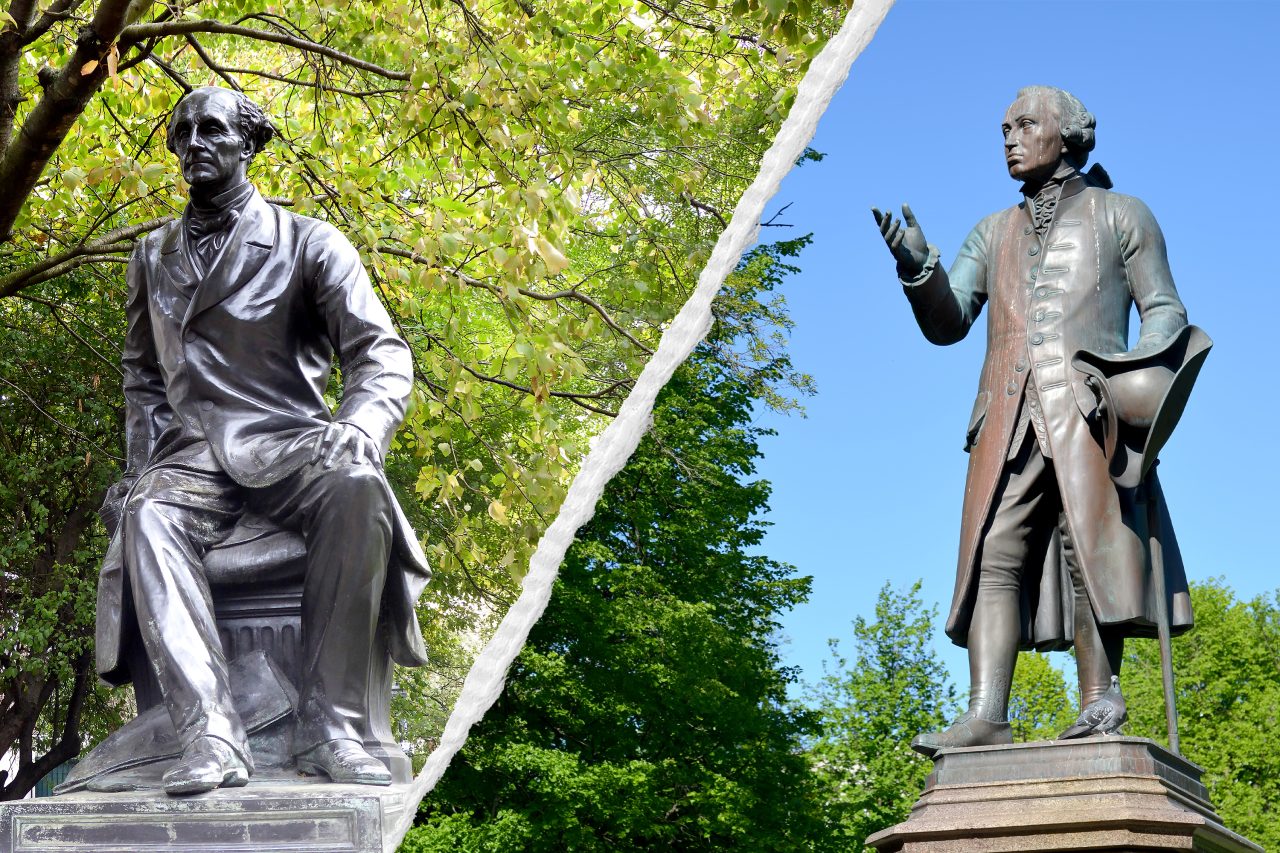
Statue av John Stuart Mill og Immanuel Kant
Why does this matter today?
John Stuart Mill’s ideas still matter because our choices affect other people every day. We make decisions all the time, what we say, what we share, and how we treat others.
Mill would ask:
Does what you do make things better or worse for the people around you?
Even small choices matter; being kind, helping someone or thinking before you act.
Think for yourself
Have you ever made a choice that made someone else happy How did it feel?
Do you think it is more important to follow rules, or to think about what will happen?
Which way of thinking suits you best, Mill’s or Kant’s? Why?
1 / 2

Løse globuspuslespillet
Sources
- John Stuart Mill. https://plato.stanford.edu/entries/mill/
- Mill’s Moral and Political Philosophy. https://plato.stanford.edu/entries/mill-moral-political/
- Mill, John Stuart: Ethics | Internet Encyclopedia of Philosophy. https://iep.utm.edu/mill-eth/
- Utilitarianism | Definition, Philosophy, Examples, Ethics, Philosophers, & Facts | Britannica. https://www.britannica.com/topic/utilitarianism-philosophy
- The History of Utilitarianism (Stanford Encyclopedia of Philosophy). https://plato.stanford.edu/entries/utilitarianism-history/
- John Stuart Mill Amendment – UK Parliament. https://www.parliament.uk/about/living-heritage/evolutionofparliament/houseofcommons/reformacts/from-the-parliamentary-collections/collections-reform-acts/great-reform-act112/
- Utilitarianism: John Stuart Mill | God and the Good Life. https://godandgoodlife.nd.edu/resource/utilitarianism-john-stuart-mill/
Image and Video Rights
- Wikipedia
- Getty Images
- Getty Images
- Getty Images
- Adobe Stock
- Wikipedia / Adobe Stock
- Getty Images


