

Who was Aristotle?
Aristotle was an ancient Greek philosopher who lived more than 2,300 years ago (384–322 BCE). He was born in Stagira, a town in northern Greece, and later moved to Athens to study at Plato’s Academy. After many years of learning, Aristotle became a teacher and even taught Alexander the Great.
He was curious about many subjects, including science, nature, politics, and human behaviour. Unlike some philosophers, he believed that knowledge comes from observing the world and learning from experience. He carefully studied nature and tried to understand how things work.
One of his most important ideas was about how to live a good life. He taught that people become good by practising good habits—such as being honest, kind, and fair. These qualities are called virtues.
According to Aristotle, living well is not just about feeling happy, but about becoming the best version of yourself over time.
What are some examples of good habits you can practise in your daily life, and how might they shape who you become?
If you want to learn more, watch this video:

1 / 3


Aristoteles-statuen i Stagira i Hellas
What did Aristotle believe?
Aristotle believed that ethics is not mainly about rules or consequences, but about character. His philosophy, known as virtue ethics, focuses on the kind of person you become through your actions.
The ultimate goal, according to Aristotle, is eudaimonia, often translated as human flourishing. This means living a meaningful and fulfilling life, guided by reason.
A central idea in his philosophy is that virtues are developed through habit. We are not born virtuous; instead, we become virtuous by repeatedly choosing good actions. Over time, these actions shape our character.
Aristotle also emphasised the importance of the golden mean—the idea that virtue lies between two extremes: too much and too little. However, finding this balance requires judgment and experience, something he called practical wisdom (phronesis).
Example:
Consider dealing with conflict. Avoiding it completely may show a lack of courage, while reacting aggressively may show too much anger.
A virtuous response would involve calmly expressing your thoughts and listening to others, showing both courage and self-control.
Let’s reflect…
- Do you think being a good person is more about what you do or who you become? Explain your answer.
- Can different people disagree about what the “right balance” is in a situation? What does that mean for Aristotle’s theory?
1 / 4

En turgåer strekker ut hånden for å hjelpe en venn med å klatre opp til toppen av fjellet
What was Aristotle’s goal in life?
Aristotle argued that the ultimate goal of human life is eudaimonia, often translated as human flourishing. This concept goes beyond happiness understood as pleasure or comfort. Instead, it refers to a life that is meaningful, purposeful, and guided by reason over the long term.
For Aristotle, living well means actively developing one’s abilities and making thoughtful, balanced decisions. It involves shaping your life through consistent choices, rather than simply reacting to immediate desires.
This perspective highlights an important tension: what feels good in the short term does not always contribute to a good life overall. True fulfilment often requires effort, discipline, and reflection.
Additionally, Aristotle believed that living well is connected to participation in a community. Our relationships, responsibilities, and contributions to others all play a role in shaping a meaningful life. This means that eudaimonia is not only personal, but also social.
Imagine this situation
Consider working toward a long-term goal, such as improving in a sport, learning an instrument, or preparing for a future career. These paths require persistence and may involve frustration or failure. However, over time, they can lead to a deeper sense of achievement, identity, and purpose—something that momentary pleasure cannot provide.
So, let’s think about this…
- Do you think a meaningful life requires effort and sacrifice?
- How do your daily choices shape the direction of your life over time?
1 / 4

Tenåringer som lærer å spille instrumenter
Learning Through Experience
Aristotle argued that knowledge is not gained only through abstract thinking, but also through direct experience of the world. He believed that observation, practice, and reflection are essential for truly understanding something. This idea contrasts with the view that knowledge comes mainly from theory or instruction.
For Aristotle, experience helps us develop judgment and refine our understanding over time. By engaging with real situations, we learn to recognise patterns, make better decisions, and adjust our actions. Importantly, this process includes trial and error. Mistakes are not failures, but necessary steps in developing knowledge and practical wisdom.
This approach also relates to how we grow as individuals. Through repeated experiences, we not only gain skills but also shape how we think and respond to challenges.
Example
Consider learning to work in a team. You may read about teamwork, but real understanding comes from participating in group projects. You might experience disagreements, misunderstandings, or unequal effort. Over time, these experiences teach you how to communicate, cooperate, and solve problems more effectively.
Let’s reflect
How does experience shape the way you make decisions?
Do you think it is possible to truly understand something without experiencing it? Why or why not?
1 / 4

En gruppe studenter som arbeider med et studieprosjekt
Why Do Habits Matter?
Aristotle believed that habits are central to personal development and ethical life. Rather than being born with fixed qualities, individuals shape their character through repeated actions. Over time, these actions become stable patterns of behaviour—habits—that influence how we think, feel, and respond to different situations.
For Aristotle, habits reduce the need for constant decision-making. When good habits are formed, acting in a thoughtful and balanced way becomes more natural. This is why he emphasised the importance of early practice and consistency. Small, repeated actions gradually build a foundation for long-term growth.
At the same time, this idea highlights a challenge: negative habits can form in the same way. This means that becoming a better person requires awareness, effort, and sometimes change.
Consider this
Think about how you manage your time. If you regularly procrastinate, it can become a habit that affects both your performance and your stress levels. However, by gradually building routines—such as planning your tasks or starting your work earlier—you can replace that habit with more productive behaviours. Over time, these new habits can change how you approach your responsibilities.
Have you ever thought about how your habits shape your identity?
Why can it be difficult to change a habit once it is formed?
1 / 4

Tenåring som sitter på sengen med en bærbar PC
Using Reason to Make Good Choices
Aristotle believed that reason is a defining feature of human beings and plays a central role in living a good life. According to him, making good choices is not simply about following feelings or impulses, but about thinking carefully, reflecting on situations, and acting with understanding.
Reason allows us to evaluate different possibilities, consider consequences, and find balanced responses. It also helps us regulate our emotions, especially in challenging situations where immediate reactions may not lead to the best outcomes. Aristotle believed that developing this ability requires practice and experience, and that good judgment improves over time.
This idea is closely connected to what he called practical wisdom, the ability to make the right decision in the right situation. Practical wisdom is not just about knowing what is right, but about applying that knowledge in real life.
Consider this situation
Imagine you feel pressured by others to do something you are unsure about. Acting on impulse might lead you to follow the group without thinking. However, using reason allows you to pause, reflect on your values, and decide what is truly right for you, even if it is difficult.
Do you think good decisions come more from thinking or from feeling?
How can you develop better judgment over time?
1 / 4

En ettertenksom tenåring på jakt etter en løsning
What Does It Mean to Live a Good Life?
For Aristotle, a good life is shaped by consistent choices that reflect thoughtful judgment and personal growth. It requires developing one’s abilities, engaging with challenges, and acting in ways that contribute to both personal well-being and the well-being of others. This means that living well is an ongoing process, not a single achievement.
Aristotle also emphasised the social dimension of a good life. Relationships, community, and participation in society all play a role in shaping a meaningful existence. Living well is not only about individual success, but also about how we relate to and support others.
Think for yourself
Do you think a good life is more about happiness, success, or purpose? Why?
How do challenges and difficulties contribute to living well?
In what ways do other people influence your ability to live a good life?
1 / 3

En rekke elever som går sammen i parken
Why is Aristotle relevant today?
Aristotle remains highly relevant because his ideas address fundamental questions about how to live, make decisions, and develop as individuals. Questions that continue to shape modern life.
In contemporary society, where people face constant information, social pressure, and immediate gratification, Aristotle’s emphasis on long-term growth and balanced decision-making is especially valuable. His ideas encourage us to pause, reflect, and consider not only what we do, but who we are becoming through our actions.
Aristotle’s philosophy also highlights the importance of community and relationships, which remain central in education, work, and social life. His ideas can be applied to modern ethical challenges, including digital behaviour, leadership, and personal responsibility.
Let’s question ourselves!
Consider how people interact online. It is easy to respond quickly, judge others, or follow group opinions without reflection. Applying Aristotle’s ideas means thinking carefully, acting respectfully, and considering the long-term impact of our behaviour.
In what ways can Aristotle’s ideas help people deal with modern challenges?
How does technology influence the way we develop habits and character?
1 / 3

Portrett av en tenåring ved en mobilutstilling
Aristotle vs. Confucius
Aristotle and Confucius were two influential philosophers from different cultural traditions who both explored how human beings can live well. While they share important similarities, their approaches highlight different aspects of ethical life.
Aristotle’s philosophy centres on the development of individual character through habits and the cultivation of virtues. He emphasises balance, practical judgment, and the gradual process of becoming a good person.
Confucius, in contrast, places greater importance on social relationships, moral duties, and harmony within society. His ideas focus on respect, proper behaviour, and fulfilling one’s role within family and community.
Despite these differences, both thinkers agree that ethical life is not only about following rules, but about ongoing personal development and reflection.
Consider this situation
Imagine you are dealing with a conflict in a group. Aristotle would encourage you to find a balanced and thoughtful response based on good judgment. Confucius would emphasise maintaining harmony, showing respect, and considering how your actions affect relationships.
Do you think being a good person is more about individual character or relationships?
Can different cultures have different ideas about what it means to live well?
1 / 4
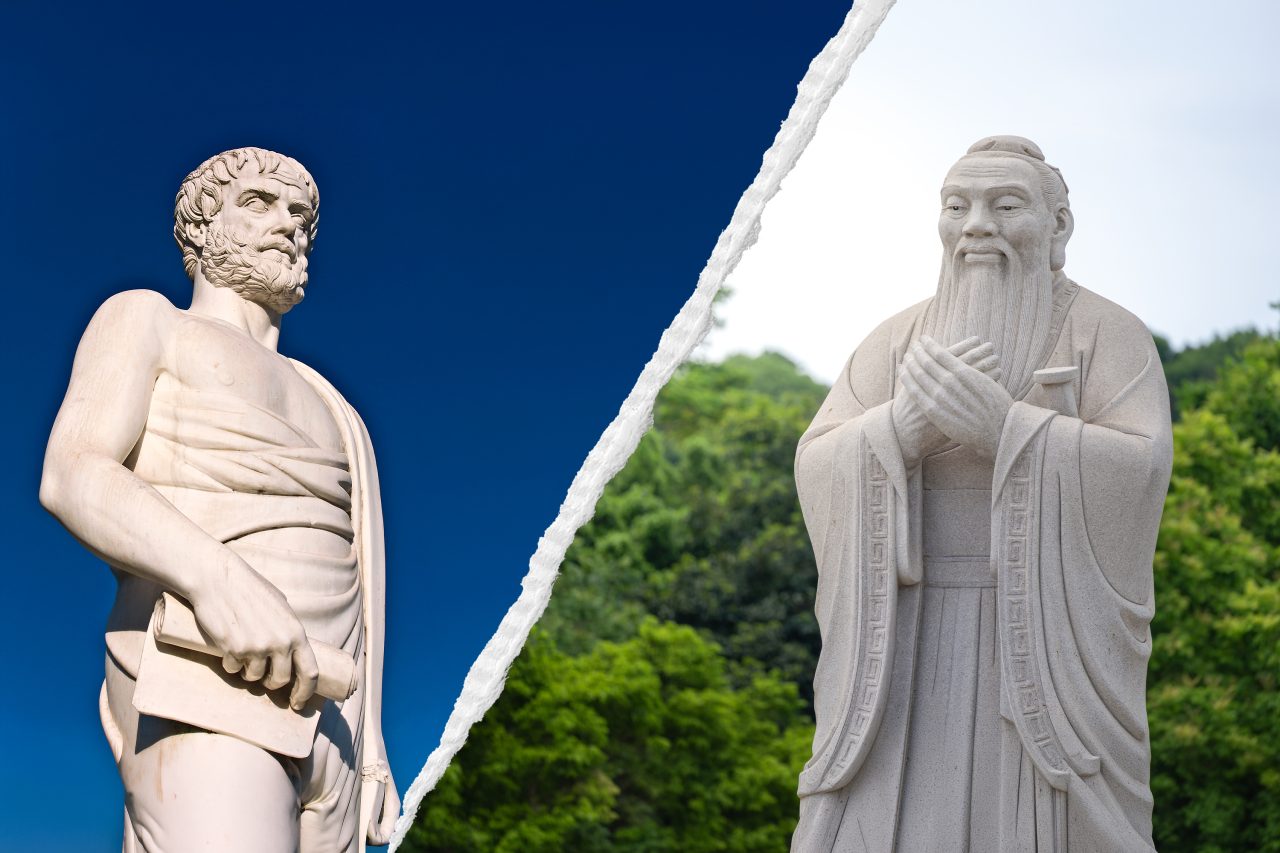
Statuer av Aristoteles og Konfucius side om side, delt av en visuell linje
Sources
- Stanford Encyclopedia of Philosophy – Aristotle’s Ethicshttps://plato.stanford.edu/entries/aristotle-ethics/
- Internet Encyclopedia of Philosophy – Aristotlehttps://iep.utm.edu/aristotle/
- Aristotle & Virtue Theory: Crash Course Philosophy #38https://www.youtube.com/watch?v=PrvtOWEXDIQ&list=PL8dPuuaLjXtNgK6MZucdYldNkMybYIHKR&index=39
- Stanford Encyclopedia of Philosophy – Confuciushttps://plato.stanford.edu/entries/confucius/
- Encyclopaedia Britannica – Aristotlehttps://www.britannica.com/biography/Aristotle
Image and Video Rights
- Getty Images
- Getty Images
- Adobe Stock
- Getty Images
- Adobe Stock
- Adobe Stock
- Getty Images
- Getty Images
- Adobe Stock / Getty Images


