

Who was Socrates?
Socrates lived in Athens in the 5th century BCE, at a time when people cared deeply about debate, persuasion, and public life.
Athens was a democracy where citizens discussed and voted on important decisions. At the same time, professional teachers called the Sophists trained people to argue convincingly, sometimes more to win than to tell the truth.
Socrates took a different approach.
He was not interested in winning arguments. Instead, he asked questions that often made people realise they could not clearly explain what they believed.
He discovered something surprising: many people sounded confident, but struggled when their ideas were examined closely.
Socrates believed that his only advantage was this:
he knew that he did not really know.
Think about how often we assume we understand something without really checking.
It happens in class, online, and in conversations with friends.
Have you ever tried to explain something and realised it was harder than you thought?
What would change if you stopped and asked:
Do I actually understand this, or do I just think I do?

1 / 3


Statue av Sokrates
What did Socrates believe?
Socrates developed a way of thinking called the Socratic method.
The idea is simple, but not easy: we should test what we believe by asking questions, and be willing to change our minds if our answers do not hold up.
Socrates often began with a simple question, such as: What does it mean to be fair?
At first, the answer might seem clear. But as he asked more questions, problems started to appear. The answer did not always make sense.
This can feel uncomfortable.
It means accepting that we might be wrong, even about things we feel completely sure about.
Example: What is a “good friend”?
Imagine someone asks you:
What does it mean to be a good friend?
You might answer:
A good friend is someone who is always there for you.
But what if your friend is doing something harmful? Should you still support them?
If you follow Socrates’ way of thinking, you do not stop there. You keep asking questions.
And suddenly, the answer is not so simple anymore.
Have you ever been in a situation where being a good friend was not as straightforward as it sounds?
1 / 4

Jente som tenker med hånden på haken
The unexamined life
Socrates questioned everyone, even people with power and status.
Again and again, he showed that people who seemed confident could not always explain what they believed, and this made many people uncomfortable and angry.
Eventually, Socrates was put on trial in Athens. He was found guilty and sentenced to death. He was forced to drink poison.
According to Plato, he accepted this calmly. He believed that giving up his questions would be worse than the punishment.
During the trial, he said:
The unexamined life is not worth living.
What do you think? Should we always question what we believe, even if it leads to problems?
1 / 2

Fargerike tale-bobler formet som en hjerne med flere spørsmålstegn
Believing vs. understanding
Socrates believed that there is an important difference between thinking for yourself and simply repeating what others say.
Many people do not notice this, because ideas can feel true long before we have actually examined them.
Imagine this:
You are scrolling through TikTok and see a video where someone says: “School is useless. You don’t need it to succeed, just look at me. I dropped out and now I make more money than most people.”
The person sounds confident, thousands of people have liked the video, and the comments are full of agreement.
After a while, it starts to make sense to you too.
But then a question appears: Have you actually thought this through, or does it just sound convincing?
Socrates would say that being persuaded is not the same as understanding
Think about this:
Have you ever believed something, and then realised you could not really explain why?
1 / 3

Mange fargerike talebobler av papir
What is good about Socrates’ way of thinking?
Socrates’ approach can be seen as both honest and fair. If we examine our beliefs carefully, there is less room for anyone to claim they are right just because they are powerful, popular, or loud.
This can make conversations more genuine, because instead of trying to win an argument, we focus on understanding each other better.
You probably recognise the situation where someone gives a confident answer but cannot really explain why.
It happens in class, in group work, and in online discussions. Socrates’ way of thinking helps us notice this, both in others and in ourselves.
At the same time, his approach assumes that every person is capable of thinking independently. No one needs an expert to tell them what to believe—we can work things out by asking good questions and reasoning together.
What do you think? Is it an advantage to always be willing to question what we believe?
1 / 2

En elev som snakker med klassekameratene i klasserommet
What can be difficult?
Socrates’ way of thinking can be challenging in some situations. Asking questions is useful, but it does not always lead to clear answers.
Imagine that you are in a discussion with a friend who holds a strong opinion. As you start asking questions, you begin to show that their argument has problems, but now your friend feels attacked, and you still do not have a better answer yourself.
Is it worth questioning something if all you are left with is doubt?
Socrates would argue that honest questioning is always worth it, because accepting a weak idea is worse than the discomfort of examining it.
But not everyone would agree. Sometimes people need support, not more questions, and there are situations where we simply have to decide, even without a perfect answer.
We see a similar challenge in everyday life. In a group project, for example, one person might question every decision the team makes. This can improve the result, but it can also slow things down and frustrate the others.
So how do we know when questioning helps and when it gets in the way?
1 / 3

Forstørrelsesglass med mange spørsmålstegn
Socrates and Aristotle
Socrates and Aristotle were both philosophers, but they focused on different questions.
Socrates’ way of thinking is about examining our beliefs by asking questions—do I really understand what I think I understand?
Aristotle’s approach, on the other hand, is about practice. He believed that we become good people by developing good habits over time: am I becoming a better person through what I do every day?
You may recognise both approaches in your own life. Sometimes we need to stop and question what we believe, while at other times what matters most is how we act.
What do you think is more important: examining your beliefs, or practising good habits?
1 / 2
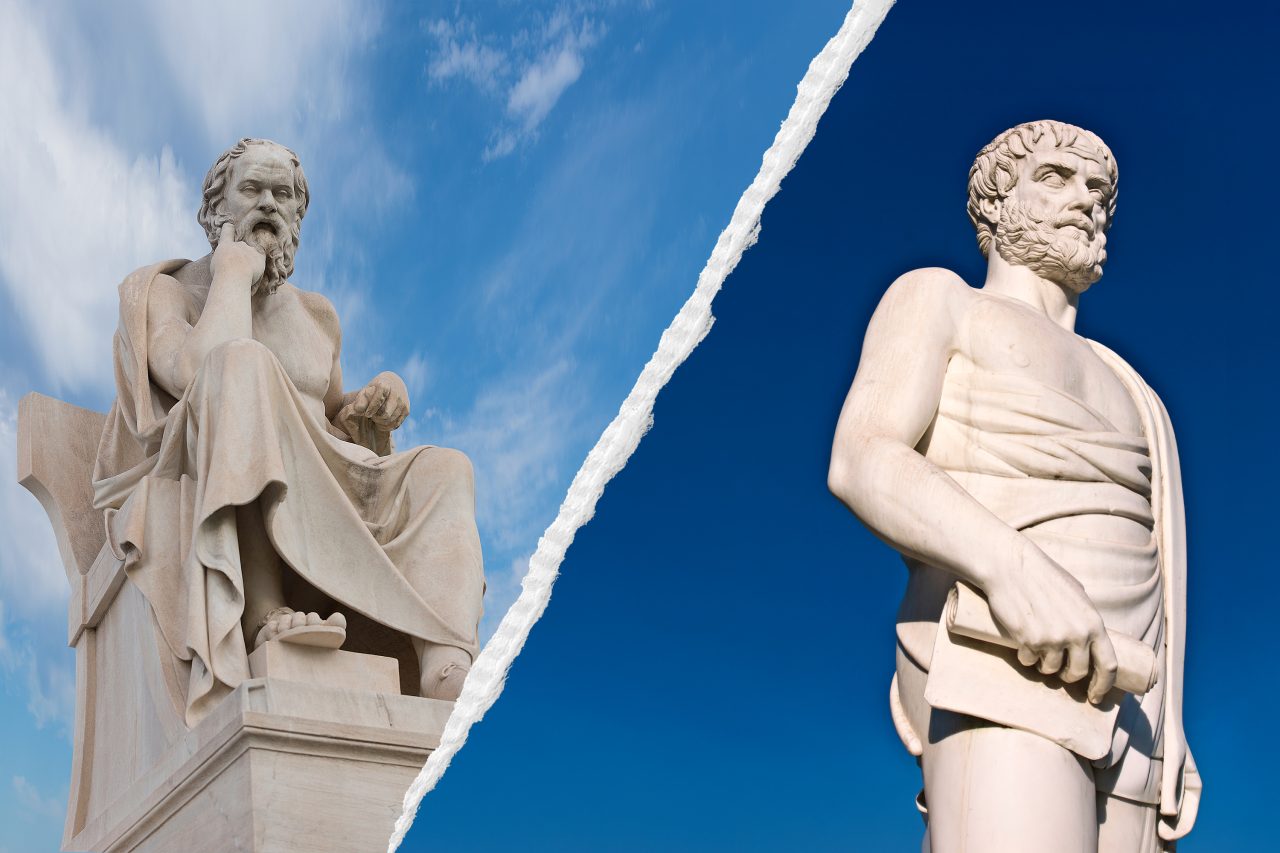
Statue av Sokrates og Aristoteles
Why is Socrates relevant today?
Socrates lived more than 2,400 years ago, but the challenges he identified have not gone away.
We face similar situations all the time, when we form opinions about a news story, decide what to share online, or react when someone disagrees with us. In each of these moments, Socrates’ question still applies: do I really have good reasons for thinking this?
It is easy to feel certain about something without ever stopping to check, especially when many people around us seem to agree. Socrates encourages us to slow down and ask honest questions about our own thinking in order to build real understanding.
Think for yourself
Have you ever believed something just because everyone around you believed it? What happened when you started to question it?
Can questioning ever cause more problems than it solves?
Think about a time when a question helped you see something differently. What was it about that question that made a difference?
1 / 3

En person som ser på en smarttelefon
Sources
- Internet Encyclopedia of Philosophy: “Socrates”. https://iep.utm.edu/socrates/
- Encyclopaedia Britannica: “Socratic method”. https://www.britannica.com/topic/Socratic-method
- University of Cambridge: “Socrates was guilty as charged”. https://www.cam.ac.uk/news/socrates-was-guilty-as-charged
- University of Chicago Law School: “The Socratic Method”. https://www.law.uchicago.edu/socratic-method
Image and Video Rights
- Getty Images
- Adobe Stock
- Getty Images
- Adobe Stock
- Getty Images
- Adobe Stock
- Getty Images / Adobe Stock
- Adobe Stock


