

Who was Socrates?
Socrates lived in Athens in the 5th century BCE, during what is often called the golden age of Greek civilisation. It was a time of democratic experimentation, intellectual ambition, and active public debate.
In this environment, a group of professional teachers known as the Sophists taught rhetoric, the art of persuasive argument, often without concern for whether the arguments were actually true.
Rather than following this tradition, Socrates spent his days in streets and public spaces, engaging people in conversation. He was not interested in showing what he knew, but in examining whether what others claimed to know could stand up to careful questioning.
His student Plato tells us that the Oracle at Delphi once declared Socrates the wisest person in Greece.
Instead of accepting this, Socrates treated it as a problem to investigate. He questioned those who were considered wise and discovered that those most confident in their knowledge were often least able to explain it.
He concluded that he was wiser only in recognising the limits of his own understanding.
There is something unsettling about this idea. Most of us prefer to believe that we understand things well.
What would it mean to consider that some of our deepest beliefs might not survive careful examination?

1 / 4

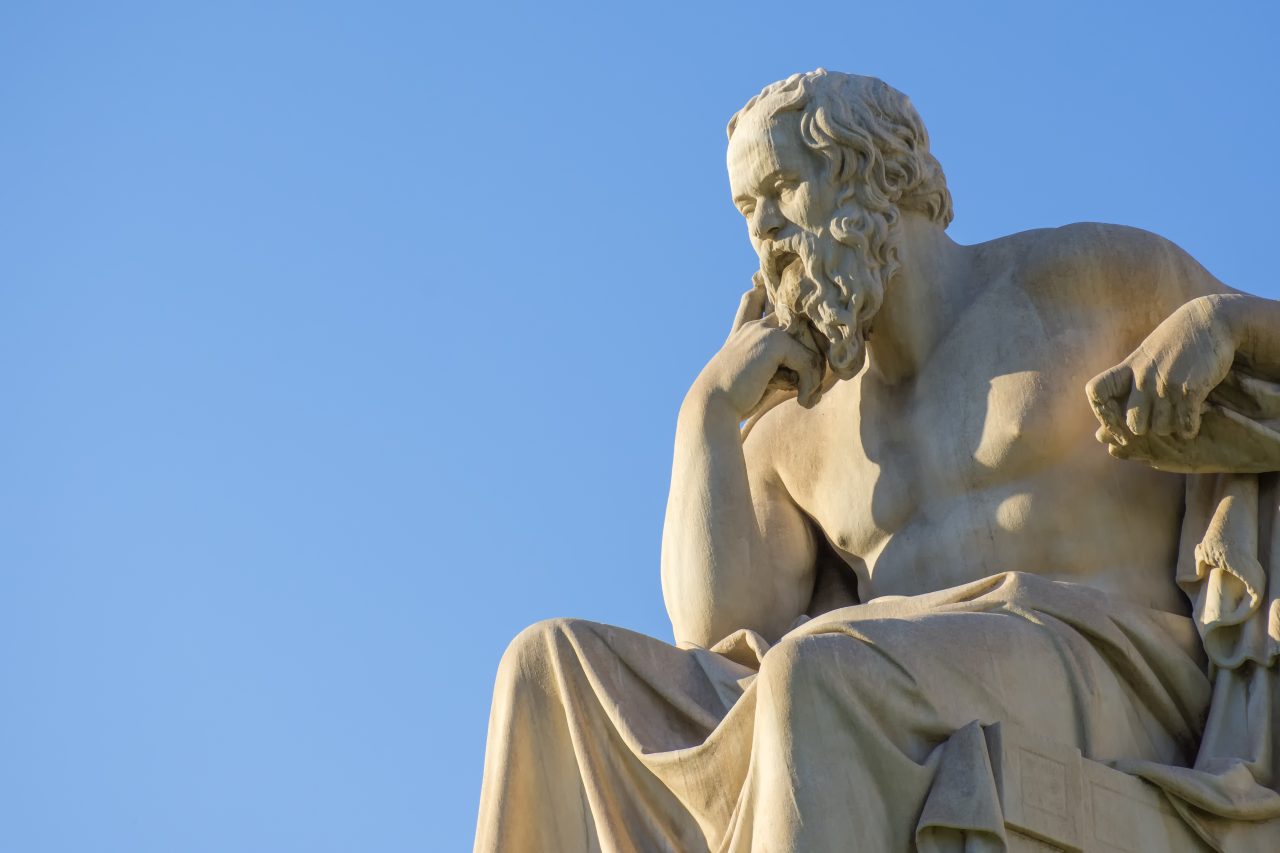
Statue av Sokrates
What did Socrates believe?
Socrates developed a way of thinking now known as the Socratic method, elenchus in Greek.
It is built on a simple but demanding idea:
any belief worth holding should be able to withstand careful questioning.
Socrates would often begin with a question such as: What is justice?
At first, the answer might seem clear. But as he asked follow-up questions, problems began to appear. The answer did not always hold together. Sometimes it even contradicted other things the person believed.
This process often led to something unexpected.
Instead of clarity, people reached a state the Greeks called aporia, a moment of confusion, where what once felt certain no longer seems secure.
This was not a failure.
For Socrates, this moment mattered most. It is the point where thinking actually begins, when we realise that our first answer was too simple.
Example: What is a “good friend”?
Consider a question that seems simple:
“What does it mean to be a good friend?”
An immediate answer might be:
“A good friend is someone who supports you no matter what.”
Socrates would press further:
“No matter what? Even when you are making a serious mistake? Would a good friend stay silent while you harm yourself or someone else?”
Perhaps you revise your answer:
“A good friend is honest, even when the truth is difficult.”
But Socrates would not stop there:
“What if honesty is delivered without care? Can blunt honesty damage a friendship just as much as dishonesty?”
Now the question is no longer simple.
Is a good friend loyal or honest?
Supportive or challenging?
Kind or truthful?
It turns out that the first answer was not wrong.
It was just too simple.
This is what Socrates reveals:
Questions we think are easy, often become difficult when we examine them closely.
1 / 5

Jente som tenker med hånden på haken
The unexamined life
At his trial in 399 BCE, Socrates made a claim that has echoed through the history of philosophy:
The unexamined life is not worth living.
This was not a dramatic exaggeration. He meant it literally, because Socrates believed that a life where we never question what we think about right and wrong, about truth, about who we are, is missing something essential.
Not because we get the wrong answers, but because we never really think at all.
Throughout his life, Socrates tested people’s beliefs in public, politicians, poets and teachers.
Again and again, he found the same thing: people spoke with confidence, but struggled to explain what they actually meant.
This made him unpopular.
Eventually, he was put on trial, found guilty, and sentenced to death. He was forced to drink poison.
According to Plato, Socrates accepted this calmly. He believed that giving up his way of questioning would be worse than dying.
This leaves us with a difficult question: What happens in a society where asking questions is seen as a problem?
And closer to home: What happens if we never question what we believe?
1 / 3

Fargerike tale-bobler formet som en hjerne med flere spørsmålstegn
Believing vs. understanding
Socrates noticed something uncomfortable:
People often believe things they have never really thought through. Not because they are careless, but because ideas are easy to pick up. From friends, from school, from social media, from people who sound confident.
This was not just a problem in ancient Athens. It still happens all the time. Many people do not notice this difference.
Imagine this:
You see a video on TikTok where someone says: “School is useless. You don’t need it to succeed.”
They continue:
“Just look at me. I dropped out, and now I make more money than most people.”
The person sounds confident, and thousands of people have liked the video. The comments say: “So true.”
After a while, you start to think the same.
Now consider another situation:
You are in a discussion about grades at school and say: “Grades are unfair. Some people always get better results than others.”
You argue strongly for this, but then someone asks: “What do you actually mean by unfair?”
As you try to answer, you realise it is not so easy to explain. Maybe you have never really thought it through.
Instead, you find yourself repeating something you have heard, without being able to explain it yourself.
For Socrates, this moment matters. It is the moment when thinking begins, when you notice the gap between what you say and what you actually understand.
Do you recognise that gap in your own thinking?
1 / 4

Mange fargerike talebobler av papir
What is good about Socrates’ way of thinking?
Socrates offers something demanding, but valuable. A way of testing what we think instead of just trusting it.
Imagine that you are in a discussion and feel completely sure that you are right. Then someone starts asking simple questions.
At first, you answer easily, but after a while, the questions become harder. Your answers do not quite fit together. That moment is uncomfortable.
But it is also where something important happens. Instead of just defending your opinion, you begin to examine it.
This is what Socrates’ method makes difficult to avoid. You cannot hide behind vague statements or confidence alone. You have to explain what you mean, and see whether it actually makes sense.
It also changes how you relate to others.
If you accept that you might be wrong, you start to listen more carefully, and you become more open to ideas that challenge your own.
There is also a political dimension to Socrates’ approach. A society in which people cannot question authority, evaluate evidence, or revise their beliefs is a society vulnerable to demagoguery and manipulation.
Socrates practised this principle radically: he treated no one as exempt from scrutiny, whether they were a general, a politician, or a celebrated poet. The assumption underlying his method is deeply egalitarian: that the ability to think belongs to everyone.
In what situations do you think this kind of questioning is most valuable? And are there contexts where it might meet resistance?
1 / 3

En elev som snakker med klassekameratene i klasserommet
What can be difficult?
The Socratic method, for all its strengths, also raises genuine difficulties. One of the most frequently noted is that Socrates was far more effective at exposing flawed reasoning than at constructing alternatives. Many of the dialogues recorded by Plato end in aporia.
Imagine being shown, through careful questioning, that your understanding of fairness contains contradictions, and then being offered nothing in its place.
The experience can feel more like disorientation than progress.
Would you accept that kind of exchange? Is it enough to know that your answer is flawed, even if no better answer is offered?
There is also the question of how the method is applied. Philosophical questioning, when conducted with genuine curiosity, can open minds, but the same technique, used carelessly or aggressively, can just as easily shut them down.
The difference between an inquiry that empowers and one that humiliates often depends less on the questions themselves than on the spirit in which they are asked.
Have you experienced a question that helped you think? What about one that simply made you feel wrong? What made the difference?
A further challenge concerns the relationship between questioning and action.
Some situations demand decisions before all doubts have been resolved, a leader facing a crisis, a doctor treating a patient, a citizen casting a vote. Perpetual questioning, without a willingness to commit, risks becoming a form of paralysis. This tension sits at the heart of Socrates’ legacy. His method is indispensable for reflection, but at some point, thinking must lead to action.
Does constant questioning make us wiser, or can it also hold us back? Where is the balance between examining our beliefs and having the courage to act on them?
1 / 4

Forstørrelsesglass med mange spørsmålstegn
Socrates and Aristotle
Socrates and Aristotle represent two foundational but distinct approaches to philosophical thinking, connected through a shared lineage: Socrates taught Plato, who in turn taught Aristotle.
Socrates’ contribution is primarily methodological. His focus was on the process of examining, testing beliefs through dialogue, uncovering contradictions, and insisting that genuine understanding must be earned through careful inquiry.
His central question can be summarised as:
Do I truly understand what I claim to know?
Aristotle’s project was different in character. Rather than focusing on questioning itself, he sought to understand what it means to live a flourishing life.
His virtue ethics holds that moral excellence is not a matter of following rules or passing intellectual tests, but of developing good character through repeated practice and habit.
His guiding question:
Am I becoming the kind of person who acts well, consistently and over time?
These two approaches are not opposed, but complementary. Without examination, we risk practising the wrong habits; without practice, our insights remain purely theoretical.
Which of these approaches speaks more directly to the challenges you face in your own life: the discipline of questioning, or the commitment to developing good habits?
1 / 3
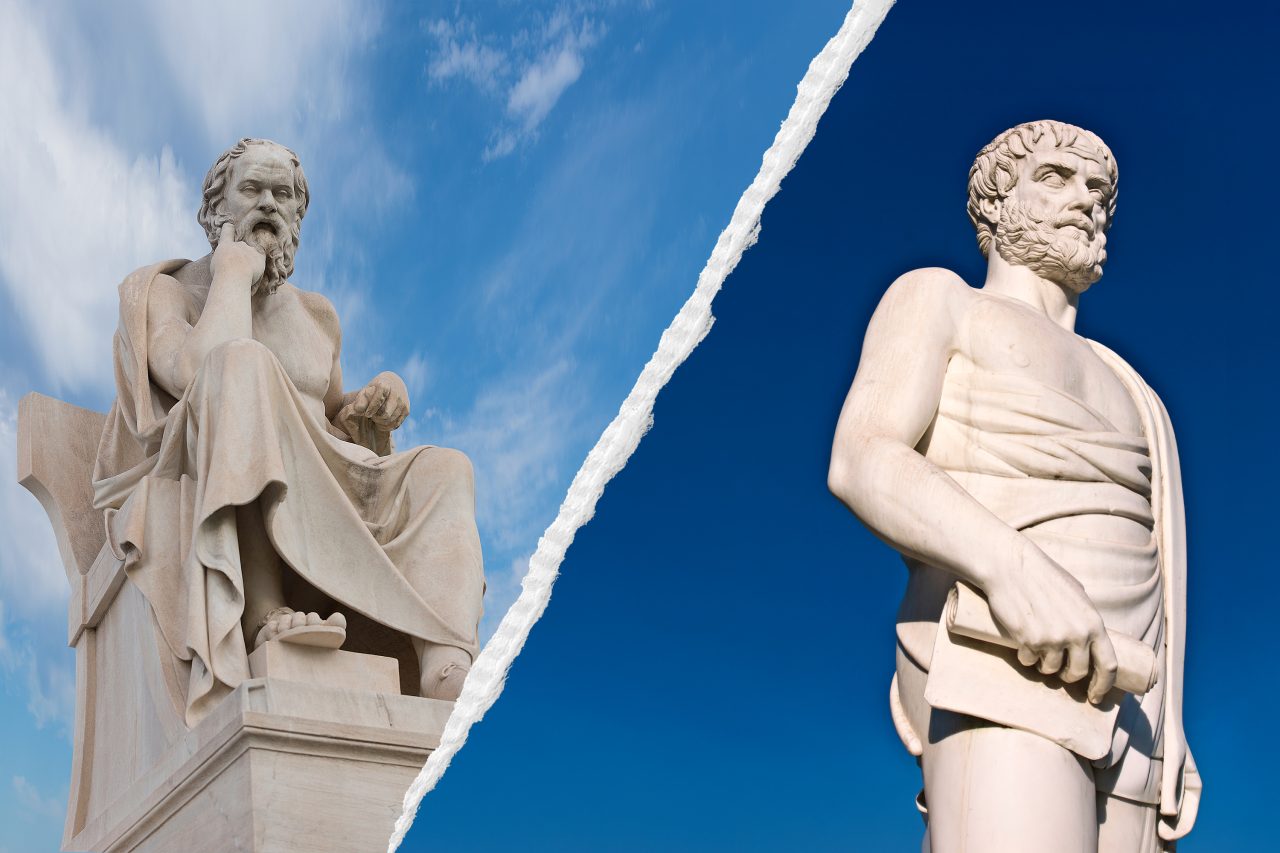
Statue av Sokrates og Aristoteles
Why is Socrates relevant today?
Socrates lived in a society where public speech had enormous power, and where the ability to persuade was often valued more than the commitment to truth. The parallel with our own time is difficult to ignore.
In a landscape shaped by social media, algorithmic curation, and the rapid circulation of unverified claims, for example, when a strong opinion spreads quickly online without anyone checking whether it is true, the skills Socrates championed, careful questioning, intellectual honesty, and the courage to say “I do not know” are not relics of an ancient curriculum. They are tools for navigating a world saturated with persuasion.
The Socratic method continues to be used in law schools, philosophy seminars, and increasingly in discussions about media literacy and digital citizenship.
Its enduring appeal lies in a simple but powerful insight: thinking well requires effort, practice, and the willingness to be uncomfortable.
Socrates paid for his commitment to inquiry with his life. That a democratic society chose to silence its most persistent questioner remains one of the most provocative facts in the history of ideas. It also reminds us that the tension between critical thinking and social conformity has never been fully resolved.
Think for yourself
What would it look like to apply Socrates’ method to a belief you have never questioned? What might you discover?
Socrates claimed that the unexamined life is not worth living. Is this an insight or an exaggeration? Where would you draw the line?
Socrates was condemned for the way he practised philosophy. Can you think of situations today where persistent questioning is treated as a problem rather than a contribution?
1 / 4

En person som ser på en smarttelefon
Sources
- Internet Encyclopedia of Philosophy: “Socrates”. https://iep.utm.edu/socrates/
- Encyclopaedia Britannica: “Socratic method”. https://www.britannica.com/topic/Socratic-method
- University of Cambridge: “Socrates was guilty as charged”. https://www.cam.ac.uk/news/socrates-was-guilty-as-charged
- University of Chicago Law School: “The Socratic Method”. https://www.law.uchicago.edu/socratic-method
Image and Video Rights
- Getty Images
- Adobe Stock
- Getty Images
- Adobe Stock
- Getty Images
- Adobe Stock
- Getty Images / Adobe Stock
- Adobe Stock


